In an earlier post, I examined excess mortality in the USA and its causes in the covid period in comparison with a group of the five largest European countries: Germany, France, Italy, Spain and the United Kingdom (“Europe 5”). Data is now available for 2023 for all these countries except Australia, and I have updated my analysis to see whether life expectancy has caught up to pre-pandemic levels and whether the USA has continued to lag behind the Europe 5.
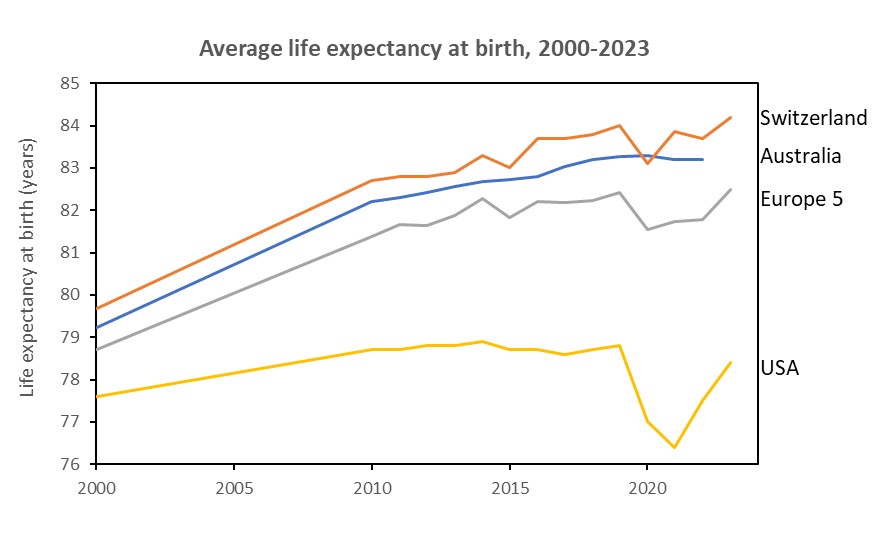
Life expectancy at birth in Switzerland and the Europe 5 has now rebounded to pre-pandemic levels. The USA, worse hit by covid, has also rebounded, but has not yet returned to pre-covid levels. Life expectancy at birth in the USA reached 78.4 years in 2023, 4.1 years behind the Europe 5 with life expectancy at birth of 82.5 years. A previous analysis found a life expectancy difference between red (republic-voting) and blue (democrat voting) states in the USA of 4.3 years.
I combined data on a population-weighted basis for five large European countries (labelled Europe 5 in the graph above) to create a composite, whose combined population size is very similar to that of the United States. Grouping these larger European countries to provide a mortality standard also creates a larger and more diverse population for comparison with the USA. Comparison with single smaller countries may be confounded by difference in various factors affecting mortality such as climate, diet, social history, and healthcare delivery.
I include data for Switzerland and Australia and have also included them in the graph below. Why? Because these are the two countries I have lived in for substantial parts of my life, and also are two countries with very high life expectancies. in the top 10 countries globally.
These differences may not seem particularly large, so I have put them into context by doing some disease elimination calculations for the USA. Using the USA national life table for the year 2019 together with estimates of the cause of death distributions by age and sex for the USA in 2019 (taken from the IHME GBD2019 study data available here), I estimated the increase in US life expectancy resulting from the elimination of deaths for particular causes across all age groups. The results are summarized in the table below for selected causes.
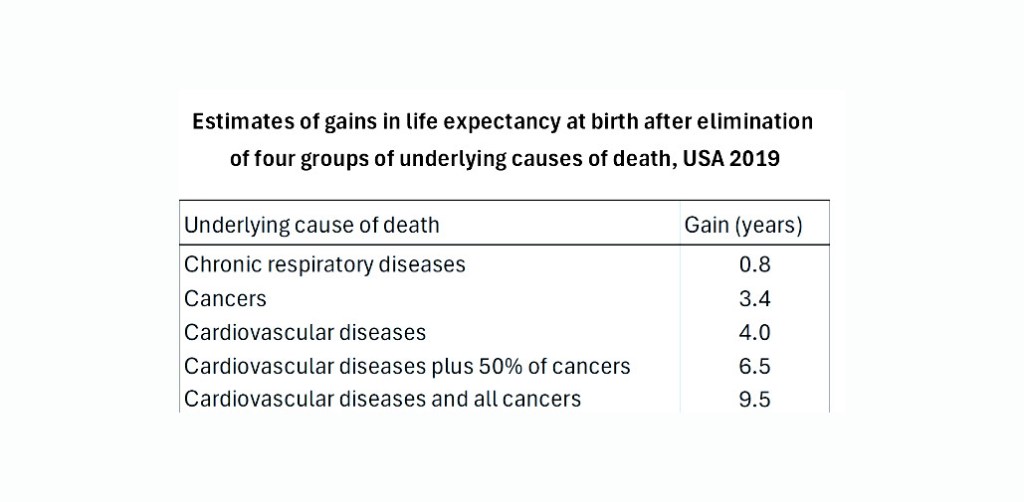
Complete elimination of all deaths due to cancer at all ages would increase US life expectancy at birth by 3.4 years- Complete elimination of cardiovascular diseases (heart disease, strokes, etc) would increase US life expectancy by 4.0 years, not quite enough to raise US life expectancy to that of the population of the Europe 5 countries in 2023. To raise the US life expectancy to that of Switzerland in 2023 would require eliminating all cardiovascular disease deaths plus around 30-40% of cancer deaths. That would amount to eliminating nearly 60% of all US deaths.
It might seem surprising that the elimination of 60% of deaths would result in “only” a 6.5 year increase in life expectancy. This is because in countries with high life expectancies, the vast majority of deaths occur at older ages where the age-specific death rate is rising almost exponentially. A large reduction in an age-specific death rate thus means that the age cohort only needs to live another six or seven years before their death rate reaches the same level as it was at the earlier age prior to the disease elimination.
The major factors causing the US life expectancy to be so far behind the average for Europe 5 are largely the same as those I identified in an earlier post: overweight and obesity, drug use and overdose, suicide, homicide, and lack of health insurance. Covid was also an important contributor to the difference in 2020 and 2021.


 Colin Mathers