An exclusive “interview”

Murray, the anonymous health statistician whose distinctive style of mischievous political graffiti adorns journals around the world from London to Seattle, doesn’t “do” interviews. The world’s most anonymous global health researcher has famously remained silent but for the statements he makes with his statistics.

Until now. In his only tabloid interview, the elusive scientists talks about his much-discussed papers, his anonymity and his aims for world domination. All off the record and confidential, of course.

Continue reading

Posted in Other | Tagged , | Leave a comment

Preterm birth is now the leading cause of death globally for children under age 5

For the first time in history, the complications of preterm birth outrank all other causes as the world’s number one killer of young children. This was the main finding of a paper we published in the Lancet in 2014 (https://colinmathers.com/2014/10/03/ending-preventable-child-deaths-by-2030/).

Continue reading

Posted in Global health trends, World Health Organization | Tagged , , | Leave a comment

Why are death rates falling at older ages — will these trends continue?

Life expectancy at age 60 years has improved steadily in the past three decades in developed countries and in many developing countries. A paper written with colleagues Gretchen Stevens, Ties Boerma, Richard White and Martin Tobias, published in the Lancet this week (http://www.thelancet.com/series/ageing), looks more closely at improvements in older age life expectancy and asks whether they vary by country and region, whether mortality is being compressed into a narrower band of older ages as we approach an upper limit for human life span, and what are the main causes of the decreases in death rates of older people.

Continue reading

Posted in Global health trends | Tagged , , | Leave a comment

Ending preventable child deaths by 2030

Trend data for causes of child death are crucial to inform priorities for improving child survival by and beyond 2015. With academic collaborators at Johns Hopkins University, London School of Hygiene and Tropical medicine and Edinburgh University, we have just published a paper in the Lancet this week on causes and trends in child mortality from 2000 to 2013, with cause-specific mortality projections and scenarios to 2030 and 2035.

http://www.thelancet.com/journals/lancet/article/PIIS0140-6736%2814%2961698-6/fulltext#article_upsell

Continue reading

Posted in Global health trends, Projections, World Health Organization | Tagged , , , | 3 Comments

Premature death can be reduced by 40% in 20 years!

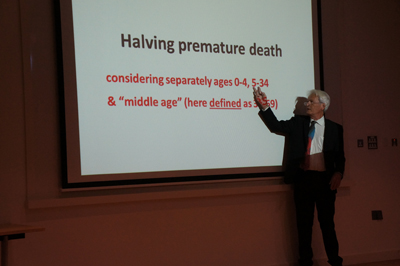
A paper by 16 international co-authors published last Friday in the Lancet, suggests that, with sustained international efforts, the number of premature deaths could be reduced by 40% over the next two decades (2010 – 2030), halving under – 50 mortality and preventing a third of the deaths at ages 50 – 69 years.

http://www.thelancet.com/journals/lancet/article/PIIS0140-6736%2814%2961591-9/fulltext

201371013348353Between 2000 and 2010, child deaths fell by one-third worldwide, helped by the fourth Millennium Development Goal (MDG) to reduce child deaths by two-thirds; and premature deaths among adults fell by one-sixth, helped by MDG 5 to reduce maternal mortality and MDG 6 to fight AIDS, malaria and other diseases. According to co-author, Sir Richard Peto, if the world begins an intense effort to further eliminate preventable causes of death, including injuries, we could see a steeper decline.

My contribution to the paper was to provide the estimates of deaths by cause, age and sex for all countries of the world, as well as projections of cause-specific deaths to 2030. Moderate acceleration of the trends seen from 2000—2010 could be feasible, and good evidence of how the reduction in non-communicable disease (NCD) mortality might be achieved was identified in an earlier paper I was involved in (Kontis et al. — see post of 3 May 2014).

The UN will formulate ambitious Sustainable Development Goals for 2030, including one for health. Feasible goals with some quantifiable, measurable targets can influence governments. This paper proposes a quantitative health target, “Avoid in each country 40% of premature deaths (under-70 deaths that would be seen in the 2030 population at 2010 death rates), and improve health care at all ages”. This could be achieved in 2030 if the following subtargets were met: avoid two-thirds of child and maternal deaths; two-thirds of tuberculosis, HIV, and malaria deaths; a third of premature deaths from NCDs; and a third of those from other causes (other communicable diseases, undernutrition, and injuries). These challenging subtargets would halve under-50 deaths, avoid a third of the (mainly NCD) deaths at ages 50—69 years, and so avoid 40% of under-70 deaths.

Posted in Global health trends, Projections | Tagged , , , | Leave a comment

Child death rates falling faster – annual number of deaths halved since 1990

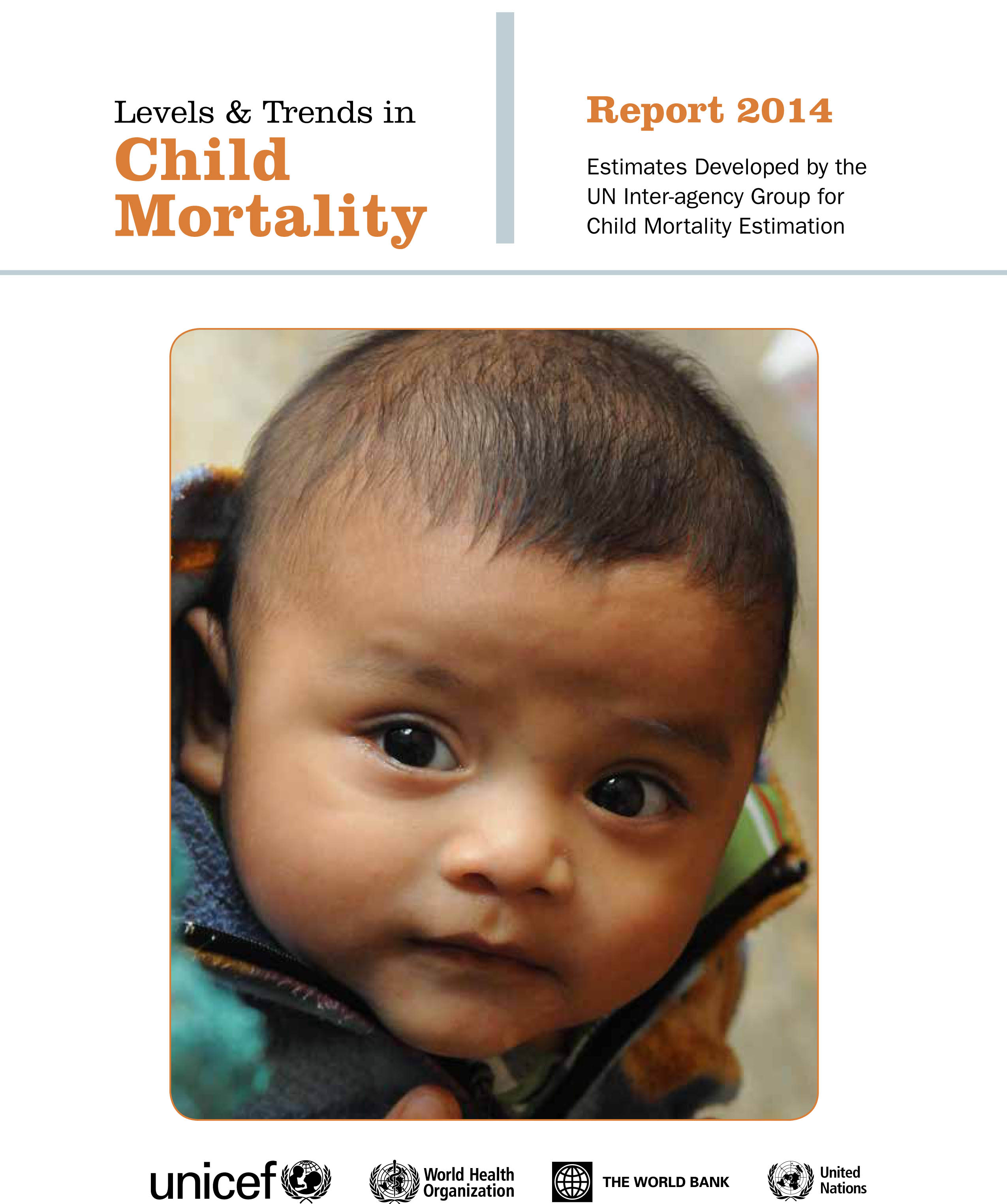
unicef child mortality report 10 Sep 2014-1The United Nations Inter-agency Group for Child Mortality Estimation (UN-IGME) released new data this week showing that under-five mortality rates have dropped by 49% between 1990 and 2013. The average annual reduction has accelerated – in some countries it has even tripled – but overall progress is still short of meeting the global target of a two-thirds decrease in under-five mortality by 2015.

UNICEF also released a companion report, A Promise Renewed, which included the most recent estimates of causes of child death across the world, prepared by my team in collaboration with several academic groups. The full results on causes will be released later this month.

The new estimates show that in 2013, 6.3 million children under five died from mostly preventable causes, half the number in 1990, but still equal to nearly 17 000 child deaths each day. About 44% of these under-five deaths occur in the first month of life and about two-thirds of these in just 10 countries.

While Sub-Saharan Africa has cut under-five mortality rates by 48% since 1990, it still has the world’s highest rate – 92 deaths per 1000 live births – nearly 15 times the average in high-income countries. The leading causes of under-five deaths are pre-term birth complications (17%); pneumonia (15%); complications during labour and delivery (11%); diarrhoea (9%); and malaria (7%). Under-nutrition contributes to nearly half of all under-five deaths.

http://www.who.int/maternal_child_adolescent/documents/levels_trends_child_mortality_2014/en/

Posted in Global health trends | Tagged , , | Leave a comment

Global patterns of violence against children

The recently released UNICEF report on violence against children used our estimates ofHidden_in_Plain_Sight_report_cover_27Aug2014 child homicide rates for year 2012 from the WHO Global Health Observatory. Of course, these estimates are uncertain for countries without good death registration data. We also had access to the police and justice system statistics for homicides reported to the UNODC (see their 2013 Global Homicide Study which also quotes our draft estimates) but in many countries police statistics on homicides are incomplete, and death registration data may also be incomplete or nonexistent. WHO, the World Bank, other UN agencies and some national governments are making a concerted effort to encourage and support the implementation and improvement of civil registration systems, including death registration with cause of death.

http://www.juancole.com/2014/09/child-homicide-unicef.html

US, Iraq have same child homicide rate – UNICEF

RT America: “America leads all Western nations in the number of child homicide victims, according to a new report from UNICEF. In 2012, there were four adolescent homicides per 100,000 people in the US, which is on par with the child death toll in Iraq. RT’s Ameera David takes a look at the troubling figures.”
Posted in Global health trends, World Health Organization | Tagged , , , | Leave a comment

Preventing suicide: A global imperative

2014_report_publicationMore than 800 000 people die by suicide every year, according to WHO’s first global report on suicide prevention, published today. Some 75% of suicides occur in low- and middle-income countries. Globally, suicide rates are highest in people aged 70 years and over. In some countries, however, the highest rates are found among the young. Notably, suicide is the second leading cause of death in 15-29 year-olds globally.

Generally, more men die by suicide than women. In richer countries, three times as many men die by suicide than women. Men aged 50 years and over are particularly vulnerable. In low- and middle-income countries, young adults and elderly women have higher rates of suicide than their counterparts in high-income countries. Women over 70 years old are more than twice as likely to die by suicide than women aged 15-29 years.

My team collaborated closely with the WHO Department of Mental Health and Substance Abuse in the preparation of this report, which drew heavily on our global health statistics for causes of death (http://www.who.int/gho/en/)

Among the countries with the highest per-capita suicide rates in 2012 are South Korea, Hungary, Japan, Russia and India. Reducing access to means of suicide is one way to reduce deaths. Other effective measures include responsible reporting of suicide in the media and early identification and management of mental and substance use disorders.
Posted in Global health trends, World Health Organization | Tagged , | Leave a comment

The decline of war as a cause of human mortality

With recent events in Iraq, Syria, Gaza and parts of Africa, and shortly after the century in which millions were killed Stalin, Hitler, and Mao, Steven Pinker’s claim that the human impact of war and conflict has been diminishing may seem crazy. His book “The Better Angels of our Nature: why violence has declined” assembles data from a large number of sources and studies and points convincingly to exactly that conclusion.

“To be sure, any attempt to document changes in violence must be soaked in uncertainty. In much of the world, the distant past was a tree falling in the forest with no one to hear it, and, even for events in the historical record, statistics are spotty until recent periods. Long-term trends can be discerned only by smoothing out zigzags and spikes of horrific bloodletting. And the choice to focus on relative rather than absolute numbers brings up the moral imponderable of whether it is worse for 50 percent of a population of 100 to be killed or 1 percent in a population of one billion.”
 
“Yet, despite these caveats, a picture is taking shape. The decline of violence is a fractal phenomenon, visible at the scale of millennia, centuries, decades, and years. It applies over several orders of magnitude of violence, from genocide to war to rioting to homicide to the treatment of children and animals. And it appears to be a worldwide trend, though not a homogeneous one. The leading edge has been in Western societies, especially England and Holland, and there seems to have been a tipping point at the onset of the Age of Reason in the early seventeenth century.”
 
Stephen Pinker on the Decline of War. Source: http://www.edge.org/3rd_culture/pinker07/pinker07_index.html

Continue reading

Posted in Global health trends, World Health Organization | Tagged , , , | Leave a comment

The long-term decline of violence and global homicide rates

I have just finished reading Steven Pinker’s book “ The Better Angels of our Nature: why violence has declined”. This very large book (802 pages) is an ambitious and serious attempt to show that violence in all its forms (nonfatal, homicide, conflict, genocide, etc) has in fact declined dramatically over a very long stretches of history. Despite the ceaseless news about war, crime and terrorism, and the horrific events occurring now in Iraq, Syria, Gaza, Ukraine and elsewere, Pinker provides convincing evidence that there has been an intermittent but progressive decline in violence from prehistoric societies through to the present.

Continue reading

Posted in Global health trends, World Health Organization | Tagged , , | Leave a comment