Did the world achieve the Millenium Development Goals for health?

15239_Cover_11.5mm spine_MDGs to SDGs for Printing.pdfIn 2015 the Millennium Development Goals (MDGs) come to the end of their term, and a post-2015 agenda, comprising 17 Sustainable Development Goals (SDGs), takes their place.

My Department published a report in December 2015 assessing the achievement of the MDG health targets over the period 1990-2015, key factors influencing successes and failures and also assessing the main challenges that will affect health in the coming 15 years


(http://www.who.int/media…/…/releases/2015/mdg-sdg-report/en/).


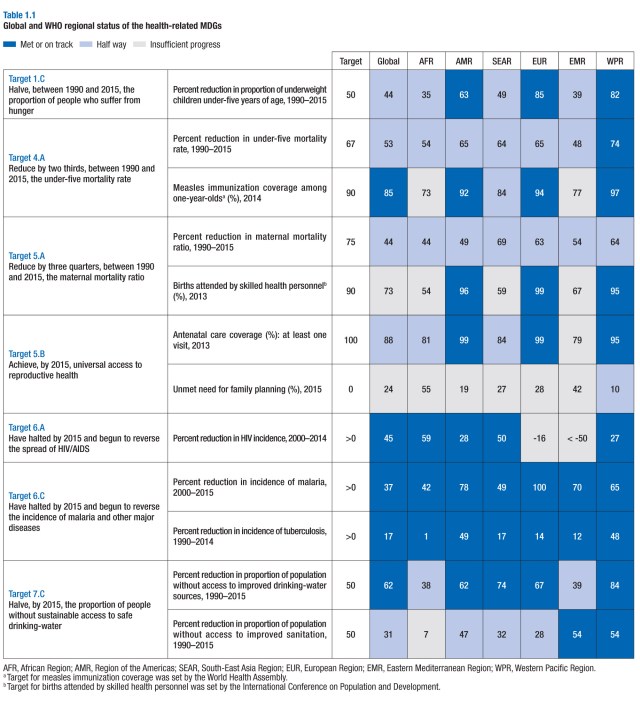
Progress towards the MDGs, on the whole, has been remarkable, including, for instance, poverty reduction, education improvements and increased access to safe drinking water. Progress on the three health goals and targets has also been considerable. Globally, the HIV, tuberculosis (TB) and malaria epidemics were “turned around”, child mortality and maternal mortality decreased greatly (53% and 44%, respectively, since 1990) despite falling short of the MDG targets (see Figure below, which shows % declines for the main MDG health indicators at regional and global levels). Regional progress has been uneven, as can be seen in Table 1.1, and substantial inequalities remain within and across countries.

FINAL_15239_Master Layout for Web

During the MDG era, many global progress records were set. The MDGs have gone a long way to changing the way we think and talk about the world, shaping the international discourse and debate on development, and also contributed to major increases in development assistance. However, several limitations of the MDGs have also become apparent, including a limited focus resulting in verticalization of health and disease programmes in countries, a lack of attention to strengthening health systems, the emphasis on a “one-size-fits-all” development planning approach, and a focus on aggregate targets rather than equity.

The new Sustainable Development Goals (SDGs) for the year 2030  are broader and more ambitious than the MDGs. SDG3 specifically sets out to “Ensure healthy lives and promote well-being for all at all ages.” Its 13 targets build on progress made on the MDGs and reflect a new focus on noncommunicable diseases and the achievement of universal health coverage.

The report includes “Snapshots” on 34 different health topics outline trends, achievements made, reasons for success, challenges and strategic priorities for improving health in the different areas. These “snapshots” range from air pollution to hepatitis to road traffic injuries, and can be viewed/downloaded individually below.

http://www.who.int/gho/publications/mdgs-sdgs/en/

Posted in Global health trends, World Health Organization | Tagged , , | Leave a comment

Maternal mortality has been almost halved in the last 25 years.

Last week, we released the latest global estimates of maternal mortality from the UN Interagency Group led by WHO (also includes UNICEF, UNFPA, World Bank and UN Population Division) www.who.int/reproductivehealth/news

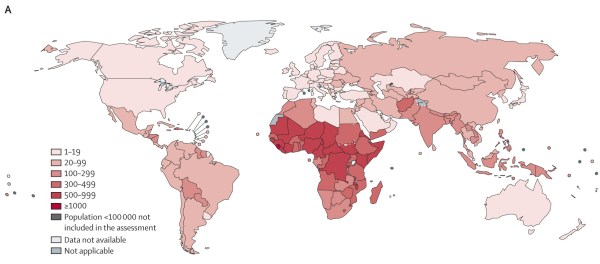
These also represent our final assessment of country, regional and global achievement (or not) of the Millenium Development Goal to reduce maternal mortality by 75% between 1990 and 2015. The map below shows estimated maternal mortality rates per 100,000 live births (MMR) in 2015.
 

MapA

Maternal deaths around the world dropped from about 532,000 in 1990 to an estimated 303,000 this year, a 44% drop. This equates to an estimated global maternal mortality ratio (MMR) of 216 maternal deaths per 100 000 live births, down from 385 in 1990. This almost halving of the risk of dying from pregnancy-related causes represents a real achievement for the world, although the goal was not reached.

The UN has established ambitious new Sustainable Development Goals for the year 2030, which includes an ambitious target to “end preventable maternal deaths” by reducing maternal deaths to fewer than 70 per 100,000 live births globally, with no country having a rate higher than 140. This is ambitious given that maternal mortality rates remain over 700 per 100,000 in middle and west Africa, and over 1000 in a number of countries. But most of these deaths are entirely preventable!

The UN assessments of country achievement of the MDG goal to reduce maternal mortality rates (MMR) by 75% between 1990 and 2015 was published simultaneously in a Lancet paper available at

http://www.thelancet.com/pb/assets/raw/Lancet/pdfs/S0140673615008387.pdf

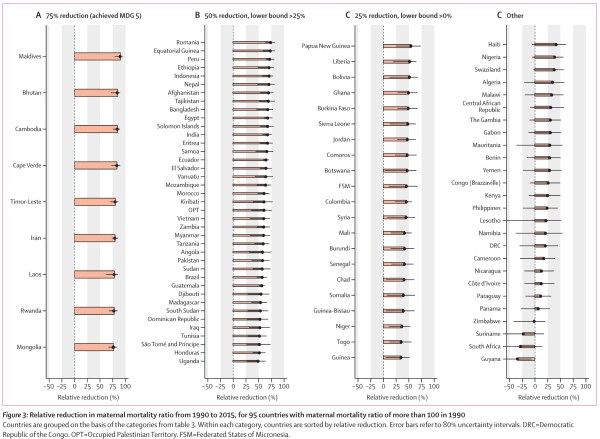
Based on point estimates, only 17 of the 194 WHO Member States achieved that goal: Belarus, Bhutan, Cambodia, Cabo Verde, Estonia, Iran, Kazakhstan, Laos, Lebanon, Libya, Maldives, Mongolia, Poland, Romania, Rwanda, Timor-Leste and Turkey. Despite this important progress, the MMR in some of these countries remains higher than the global average.

For the 95 countries with high maternal mortality in 1990 (>100 per 100,000 live births), the paper assessed country progress in four categories shown in the graph below. Only 9 of these countries achieved the MDG goal, and for 26 countries the chance that the MMR decreased is less than 90% or the point estimate of the country-specific decline is less than 25%.
Reductions


Despite global improvements, only 9 countries achieved the MDG 5 target of reducing thematernal mortality ratio by at least 75% between 1990 and 2015. Those countries are Bhutan, Cabo Verde, Cambodia, Iran, Lao People’s Democratic Republic, Maldives, Mongolia, Rwanda and Timor-Leste. Despite this important progress, the MMR in some of these countries remains higher than the global average.

By the end of this year, about 99% of the world’s maternal deaths will have occurred in developing regions, with Sub-Saharan Africa alone accounting for 2 in 3 (66%) deaths. But that represents a major improvement: Sub-Saharan Africa saw nearly 45% decrease in MMR, from 987 to 546 per 100 000 live births between 1990 and 2015.

WHO carries out a consultation with member States before releasing any statistics relating to population health outcomes at country level. We anticipated much greater interest and concern from our Member States for the consultations on the MDG targets for maternal and child health this year, as it is the target year for the MDGs and we and the UN are reporting on final achievement of the targets. However, the level of controversy about the maternal mortality estimates was substantially greater than we anticipated and much greater than for child mortality or other MDG health indicators.

We had carried out some revisions to methods to address concerns expressed by countries in previous consultations. These revisions allowed us to take better account of the trends in country data in assessing time trends. We had seen more and better data coming from countries, enhancing the accuracy of the absolute numbers of maternal deaths reported, and we were able to reduce our reliance on covariate predictors of maternal mortality for many countries. Additionally, we eliminated a classification of countries into four groups based on types of data available, which resulted in a somewhat artificial change of methods across groups.

We were aware that revisions to methods in the final year of the MDG period could be controversial, but the improvements were so substantial that it was necessary. In the event, there were a number of countries where non-technical people objected strenuously to the revisions and demanded that the older methods be applied, even though these resulted in worse trends for many of these countries. In collaboration with WHO Regional Offices, we held consultation meetings with countries and were able to convince them that the revisions resulted in “better” and generally more favourable assessments, but in any case assessments that reflected better the trends in the country data.

Even in countries with high maternal mortality, a maternal death is a relatively rare event compared to child deaths, and there are much more substantial limitations in the completeness of data. For example, for countries relying on survey reporting of deaths of sisters, the respondent may not be aware that the sister was pregnant at the time of death, and deaths associated with unsafe abortion may not be known or reported. There are particular problems in countries with high HIV prevalence to decide whether the maternal death of an HIV-positive woman is a maternal death “aggravated by the HIV status” or is an HIV-death, to which the pregnancy was incidental. Additionally, there is typically significant under-reporting in surveys of sibling deaths or deaths in household, generally for all causes of death.

Even for countries with medically certified causes of death and complete death registration, confidential enquiries and studies show that there is substantial under-identification of deaths on death certificates. On average, across all such studies there is a 33% under-reporting rate. The UN Interagency Group applies an adjustment factor based on country studies even for countries with high quality death registration systems such as Australia or France.

MMR = 100000* (number of maternal deaths)/(number of live births)

The UN method starts with data on the proportion of all deaths which are maternal (PM) derived from death registration data or survey data on deaths in the reproductive age range 15-49 years. PM is used rather than number of maternal deaths to deal with incomplete recording of deaths in death registration systems and under-reporting of deaths in surveys and censuses, on the assumption that the reporting biases are the same for maternal and non-maternal deaths.

The MMR is then calculated as

   MMR = 100000* PM *(total deaths)/(total live births)

where total deaths and total live births are derived from WHO/UN assessments of total death rates, population numbers and live birth rates. All of these may differ from country assessment of the same quantities.

As a result, the UN estimates of MMR may differ from official country estimates and from the MMR estimates reported in survey and census reports derived directly from reported data without adjustments. For all these reasons, many countries express concern about the UN estimates, and considerable communication and discussion is sometimes needed to ensure that the reasons for these differences are understood and hopefully accepted. The discussion process also often results in provision of additional data and information on data quality which improves the accuracy of estimates. For some countries, who have introduced high quality real-time surveillance systems for maternal deaths, there is now complete agreement between country and UN estimates for MMR. Since 2012, WHO, UNFPA and partners have developed Maternal Death Surveillance and Response for identification and timely notification of all maternal deaths, followed by review of their causes and the best methods of prevention. An increasing number of low- and middle-income countries are now implementing this approach.

WHO, other UN agencies and the World Bank are also ramping up efforts to assist countries to implement death registration systems and to improve the quality of death registration. It is still the case, that very few African countries have useable death registration data at country level, although some have functioning systems for urban deaths or hospital deaths, and there is increasing commitment to improve these systems.

http://www.who.int/healthinfo/civil_registration/en/

Posted in Global health trends, World Health Organization | Tagged , , , | Leave a comment

Meat DOES NOT rank alongside smoking as a cause of cancer

“Bacon, ham and sausages rank alongside cigarettes as a major cause of cancer, the World Health Organisation has said, placing cured and processed meats in the same category as asbestos, alcohol, arsenic and tobacco.”  Guardian 26 Oct 2015.

http://www.theguardian.com/society/2015/oct/26/bacon-ham-sausages-processed-meats-cancer-risk-smoking-says-who

The Guardian and most other media have got this story completely wrong. It was based on a press release from IARC (International Agency for Research on Cancer) which is part of WHO, but quite independent. What IARC did was assess the strength of the evidence, NOT the strength of the association. So processed meat had strong evidence of a VERY SMALL increased ca risk which put it in the same “quality of evidence” category as smoking which has a VERY strong risk, such that even now smoking is responsible for 25% of deaths under age 70 in UK and will kill one third of Chinese men. Red meat has a PROBABLE slight cancer risk, and in fact there is no conclusive evidence of any risk yet.

Meat DOES NOT rank alongside smoking as a cause of cancer.

Posted in World Health Organization | Tagged , , | 1 Comment

Child deaths in 2015: much accomplished, but more to do

IGME Report 2015_CoverIn 2000, world leaders agreed on the Millennium Development Goals (MDGs). MDG 4 called for a two-thirds reduction in the under-5 mortality rate between 1990 and 2015. Today the UN Interagency Group on Child Mortality Estimation (UN-IGME), which my team is heavily involved with, released its “final” assessment of the achievement of MDG 4 and global, regional and country levels. The report is available at child_mortality_trends.

Child mortality rates have plummeted to less than half of what they were in 1990. Under-five deaths have dropped from 12.7 million per year in 1990 to 5.9 million in 2015. This is the first year the figure has gone below the 6 million mark.

The global under-5 mortality rate reduced by 53% in the past 25 years and therefore missed the Millenium Development Goals (MDG) target of a 2/3 reduction. Roughly one-third of the world’s countries – 62 in all – have actually met the MDG target to reduce under-five mortality by two-thirds, while another 74 have reduced rates by at least half.

A child’s chance of survival is still vastly different based on where he or she is born. Sub-Saharan Africa has the highest under-five mortality rate in the world with 1 child in 12 dying before his or her fifth birthday – more than 12 times higher than the 1 in 147 average in high-income countries. In 2000-2015, the region has overall accelerated its annual rate of reduction of under-five mortality to about two and a half times what it was in 1990-2000. Despite low incomes, Eritrea, Ethiopia, Liberia, Madagascar, Malawi, Mozambique, Niger, Rwanda, Uganda, and Tanzania have all met the MDG target.

The world as a whole has been accelerating progress in reducing under-five mortality – its annual rate of reduction increased from 1.8 per cent in 1990-2000 to 3.9 per cent in 2000-2015. In an accompanying Lancet paper (http://www.thelancet.com/…/PIIS0140-6736%2815%2900…/abstract), we assess the progress over the last 25 years and project likely child deaths under a range of scenarios between 2015 and 2030. If countries continue to improve child survival at current rates, 69 million children will still die over the next 15 years. This rate of reduction will need to increase if the world is to meet the new Sustainable Development Goal to end preventable child deaths by 2030.


Posted in Global health trends, Projections, World Health Organization | Tagged , , , , | Leave a comment

Does the Global Burden of Disease study substantially overestimate road traffic deaths in OECD countries?

Another area of big difference between the IHME Global Burden of Disease Study and WHO global statistics relates to road injury deaths in developed countries. Dan Hogan and I have just published a comment comparing our statistics with the GBD 2010 study and with the International Road Traffic Accident Database (IRTAD) for 25 OECD countries: Mathers and Hogan 2015

This commentary accompanies a paper by leading injury experts Kavi Bhalla and James Harrison which examines why the GBD 2010 estimates for road injury deaths for these countries are 45% higher than the IRTAD numbers. The 45% higher estimate from the GBD-2010 is surprising, since these OECD countries are information-rich countries with multiple data systems and generally relatively good recording of causes of death.

Picture1Our last WHO estimates (WHO 2013 Road Safety Report) were 8% higher than IRTAD for 2010, which is plausible given differences in definition (IRTAD only includes deaths within one month of the accident) and that we assume some injury deaths coded only as “undetermined intent” are road injury deaths.

Bhalla and Harrison make a good case that the IHME overestimates is related to their assumption that a significant proportion of deaths coded to “unspecified accident” are road injury deaths, whereas in fact road injury deaths are very unlikely to end up in this category.

Posted in Global health trends, World Health Organization | Tagged , , | Leave a comment

Deaths of older children: what do the data tell us?

The Millenium Development Goals focused attention on child mortality under age 5 (where it is the highest) and the world has halved the child death rate from 1990 to 2015 (is-the-world-achieving-the-health-related-MDGs). Much less attention has been paid to older children (aged 5-14) where death rates are lower. However, this age group is one of the areas where WHO global mortality estimates differ most from those of the Seattle-based Institute for Health Metrics and Evaluation (IHME), funded by the Bill and Melinda Gates Foundation. IHME estimated that there were 820,000 deaths at ages 5-14 years in 2010, compared to 1,300,000 estimated by WHO and the UN Population Division.

Now Ken Hill, Dean Jamison and Linnea Zimmerman have analysed data from 194 DHS surveys covering 84 countries plus census data for China to estimate directly from data that there were 1,500,000 deaths in 2010 for 5-14 year olds, slightly higher than the WHO and UN estimates, but 87% higher than the estimates of IHME. The IHME relational model life table system, which is fitted to the probability of dying under age 5 and the probability of dying between aged 15 and 60, appears to underestimate for older child deaths.

The IHME has recently published updated mortality estimates for years up to 2013 (Lancet – GBD2013) and continues to estimate substantially lower numbers of deaths in the age range 5-14 than the UN estimates and the new analysis by Ken Hill and colleagues. WHO is part of the UN Interagency Group for Child Mortality Estimation (UN-IGME) which to date has focused on deaths under 5, but is investigating the feasibility to extend their estimates to include older children, using similar data and methods to those of Hill et al.

The paper by Hill et al. is published in the Lancet and available at
I have written a commentary which accompanies the paper and can be accessed at: Lancet – Hill et al 2015

I have written a commentary which accompanies the paper Lancet – Mathers 2015. There has been increasing interest in the older child and adolescent period among the global health agencies, as there is evidence that mortality rates have not declined as fast as for the under-five age range. This age range represents an important period of social and educational development, as well as onset of puberty and the older adolescent age group 15-19 is also the period of transition to adult risk exposures (driving, alcohol and drugs, reproductive risks, workplace risks etc). Both WHO and UNICEF have recently published major reports on adolescent health and mortality:

http://www.who.int/maternal_child_adolescent/topics/adolescence/second-decade/en/

http://www.unicef.org/media/files/PFC2012_A_report_card_on_adolescents.pdf

Posted in Global health trends, World Health Organization | Tagged , , , | Leave a comment

Global life expectancy increasing at the frontier rate

WHO Department of Mortality and Burden of Disease coordinator Colin Mathers told Voice of America that astonishing progress has been made in global life expectancy.

“We are estimating that over the 25 years of the Millennium Development Goal period, there has been a six year increase in life expectancy and that translates to two-and-one half years a decade. That is quite astonishing for the whole world. It partly reflects the improvements in child mortality … But also the turning around of the HIV epidemic and other causes of death. These are all reflected in life expectancy of the poorer countries,” said Mathers.

Some years ago, Oeppen and Vaupel plotted the “frontier” of human life expectancy across 300 years (Oeppen J, Vaupel JW. Broken limits to life expectancy. Science 2002;296:1029-31) . Each observation represented the highest national life expectancy at that point in time. The frontier countries included Scandinavian countries, Australia and New Zealand around the early part of the 20th century, and of course, Japan in the most recent years.  Their stunning observation was that this frontier had been increasing at an essentially constant rate of 2.5 years per decade for 200 years.  And now we see that the average global life expectancy has been increasing at essentially the frontier rate over the last 25 years – the Millenium Development Goal period. of course, the MDGs were formulated and adopted at the beginning of the 2000s, so the progress in the 1990s cannot be attributed to them, although 1990 was the base year chosen for monitoring progress to 2015. However the MDGs do appear to have resulted in accelerated progress, at least for child mortality and the infectious diseases.  Noncommunicable diseases and injuries myst await the Strategic Development Goals for 2030 now under development by the UN system.

When HIV was at its peak in Africa, Dr. Mathers says countries were experiencing 10-15 year reductions in average life expectancy. He says people globally are living on average 71 years.

http://www.voanews.com/content/progress-in-millennium-development-goals-still-not-sufficient/2765936.html

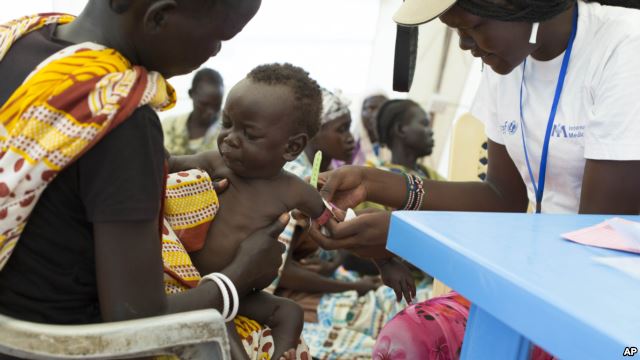
VOA File Photo: In this photo of Friday, July 25, 2014, a child with suspected malnutrition is examined at IMC nutrition program clinic in Malakal, South Sudan.

VOA File Photo: In this photo of Friday, July 25, 2014, a child with suspected malnutrition is examined at IMC nutrition program clinic in Malakal, South Sudan.

Posted in Global health trends, World Health Organization | Tagged , , , , | Leave a comment

Is the world achieving the health-related Millenium Development Goals?

We published World Health Statistics 2015 this week. It assesses progress towards the whs2015health-related goals in each of the 194 countries for which data are available. The results are mixed.

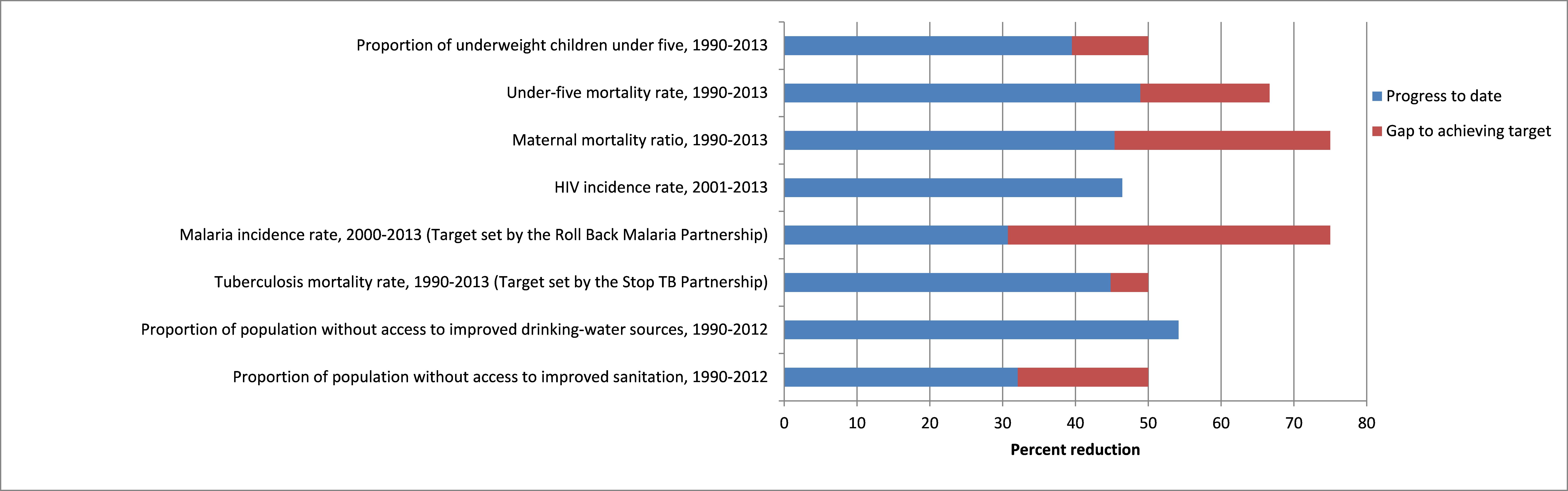
By the end of this year if current trends continue, the world will have met global targets for turning around the epidemics of HIV, malaria and tuberculosis and increasing access to safe drinking water. It will also have made substantial progress in reducing child undernutrition, maternal and child deaths, and increasing access to basic sanitation.

mdg achievment

The press release and the full report are available on the WHO website at:

http://www.who.int/mediacentre/news/releases/2015/world-health-statistics-2015/en/

http://www.who.int/gho/publications/world_health_statistics/2015/en/

Child deaths halved, but won’t reach target

Progress in child survival worldwide is one of the greatest success stories of international development. Since 1990, child deaths have almost halved – falling from an estimated 90 deaths per 1000 live births to 46 deaths per 1000 live births in 2013.

Despite great advances, this is not enough to reach the goal of reducing the death rate by two-thirds. Less than one third of all countries have achieved or are on track to meet this target by the end of this year. The top killers of children aged less than 5 years are now: preterm birth complications, pneumonia, birth asphyxia and diarrhoea.

Maternal mortality almost halved, but little progress in the worst countries

The number of women who died due to complications during pregnancy and childbirth has almost halved between 1990 and 2013. This rate of decrease won’t be enough to achieve the targeted reduction of 75% by the end of this year.

The maternal mortality ratio has fallen in every region. However, 13 countries with some of the world’s highest rates have made little progress in reducing these largely preventable deaths.

In the WHO African Region, 1 in 4 women who wants to prevent or delay childbearing does not have access to contraceptives, and only 1 in 2 women gives birth with the support of a skilled birth attendant. Less than two-thirds (64%) of women worldwide receive the recommended minimum of 4 antenatal care visits during pregnancy.

Reversing the spread of HIV

The world has begun to reverse the spread of HIV, with new infections reported in 2013 of 2.1 million people, down from 3.4 million in 2001. At current trends, the world will exceed the target of placing 15 million people in low- and middle-income countries on antiretroviral therapy (ARTs) in 2015. By the end of 2013, almost 13 million people received ARTs globally. Of these, 11.7 million lived in low- and middle-income countries, representing 37% of people living with HIV in those countries.

Increasing access to safe drinking water and sanitation

While the global target for increasing access to safe drinking water was met in 2010, the WHO African and Eastern Mediterranean Regions fall far short, particularly for poor people and those living in rural areas.

The world is unlikely to meet the MDG target on access to basic sanitation. Around 1 billion people have no access to basic sanitation and are forced to defecate in open spaces such as fields and near water sources. Lack of sanitation facilities puts these people at high risk of diarrhoeal diseases (including cholera), trachoma and hepatitis.

Beyond 2015

In September, countries will decide on new and ambitious global goals for 2030 at the United Nations General Assembly in New York. In addition to finishing the MDG agenda, the post-2015 agenda needs to tackle emerging challenges including the growing impact of noncommunicable diseases, like diabetes and heart disease, and the changing social and environmental determinants that affect health.

The draft post-2015 agenda proposes 17 goals, including an overarching health goal to “ensure healthy lives and promote well-being for all at all ages”.

Posted in Global health trends, World Health Organization | Tagged , , , | 1 Comment

Global health risks Russian edition

One of our most popular WHO reports has been Global Health Risks: Mortality and burden of disease attributable to selected major risks, published in 2009.  A Russian version has just been released by WHO, due to popular demand.

http://apps.who.int/iris/bitstream/10665/44203/8/9789244563878_rus.pdf

9789244563878_rus-1

This publication is outdated now, as there have been updated estimates for individual risk factors (eg. air pollution, alcohol) published by WHO in the last few years (WHO Global Health Observatory). Also the Global Burden of Disease Study carried out by IHME has released an expanded and updated assessment of risk factor burden for 67 risks in the Lancet in December 2012. Unfortunately, there were some errors for major risks such as alcohol, now corrected, and for many others, documentation of the analyses have not yet been released.  The most recent IHME update for risks for the year 2013 is close to finalization and the GBD2013 version may have some substantial changes compared to the GBD2010 version already released.

Posted in Global health trends, World Health Organization | Tagged , , , | Leave a comment

WHO and global health statistics

Ties Boerma and I have just published a short paper in BMC Medicine (http://www.biomedcentral.com/1741-7015/13/50) which discusses the role of WHO and other global health agencies in the preparation and publication of global, regional and country-level health statistics. There has been considerable recent debate around two key questions:

  • Our member states want to know why we do not simply publish their latest national statistics, and in some cases, can be quite unhappy that we are not doing so
  • Some academic groups also publish global health statistics in research journals, and recently, the Institute for Health Metrics and Evaluation, funded by the Bill and Melinda Gates Foundation at the University of Washington in Seattle, has been publishing comprehensive health statistics which disagree substantially in some areas with those of the UN agencies.

Continue reading

Posted in Global health trends, World Health Organization | Tagged , , | Leave a comment